

TransLink Podcast: How can transit respond to the needs of women?
TransLink Podcast: How can transit respond to the needs of women?
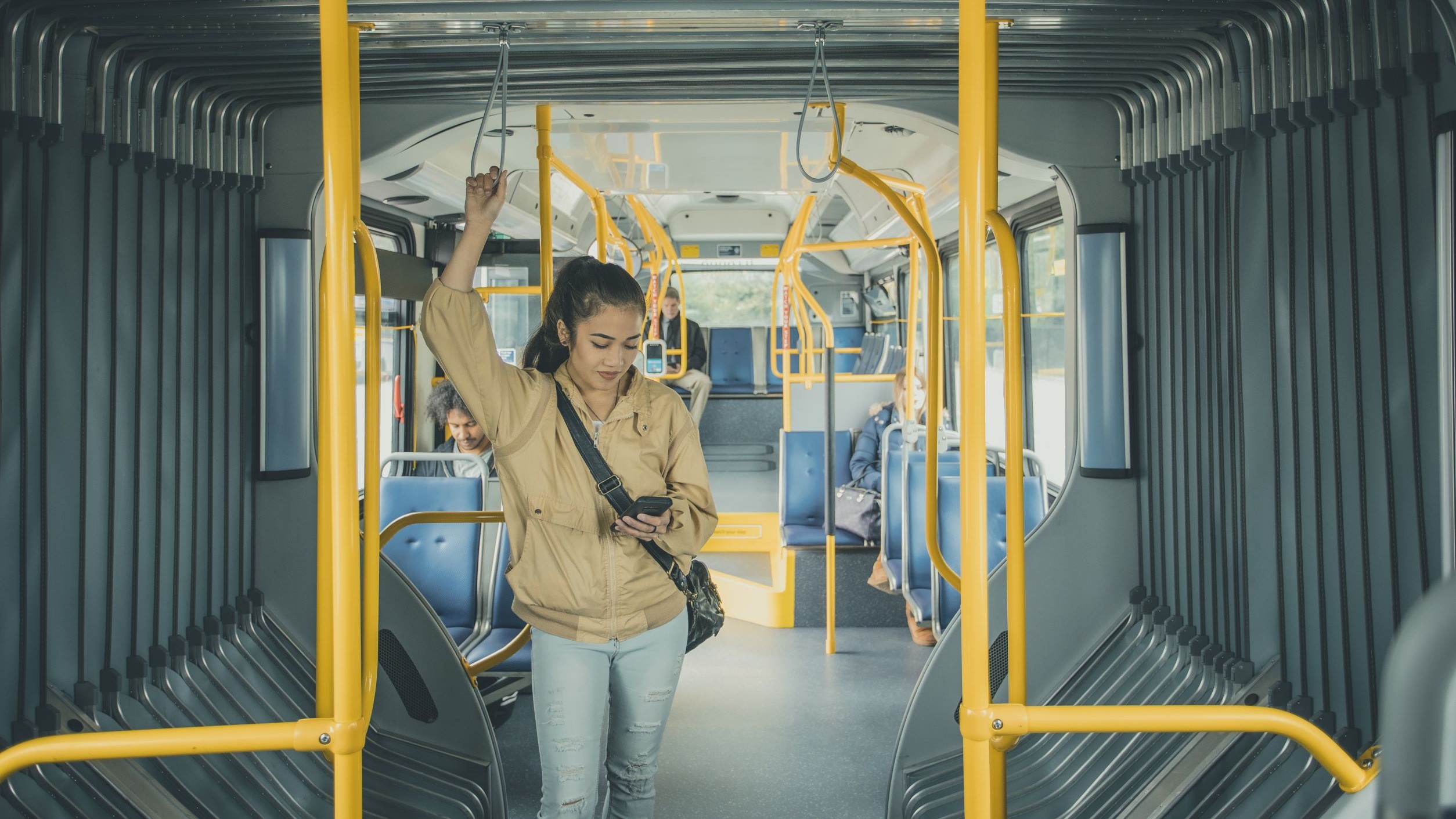
We chat with Drs. Emily Grisé and Geneviève Boisjoly about their findings in their study on understanding and responding to the transit needs of women. Emily is an assistant professor with University of Alberta, while Geneviève is an associate professor with Polytechnique Montréal.
Come behind the scenes with us as What’s the T: the TransLink Podcast with Jawn Jang reveals the voices and stories that drive Metro Vancouver’s transit system forward. Subscribe and listen everywhere you get your podcasts, including Spotify, Apple Podcasts, and Pocket Casts!
Transcript
HOST JAWN JANG: Hey, welcome to What’s the T: the TransLink Podcast. I’m your host, Jawn Jang. Here’s what we’re checking out on this episode.
[SOUND EFFECT: SUPER MARIO BROS. LEVEL UP]
JAWN: How can transit respond to the needs of women?
VOICEOVER 1: The next station is.
[INTRODUCTION MUSIC PLAYS]
VOICEOVER 2: Welcome to What’s the T: the TransLink Podcast.
JAWN: When I think of public transit, I think of it as an equalizer. Your ability to get around, which is to get to work or school or healthcare or see family and friends, isn’t just dependent on owning a car transit Democratizes mobility, but it may surprise you to hear that there’s a lot more we can do for the cities and the systems that we plan. And there’s even more we can do to make it equitable, especially when it comes to responding to the needs of women transit riders. Now these were the findings of a study completed by Drs. Emily Grisé and Geneviève Boisjoly. Doctor Emily Grisé is an assistant professor at the University of Alberta in Edmonton. Her research centre on understanding public transit systems and operations. She aims to leverage data, insights, and knowledge of people’s needs and preferences to improve the alignment of public transit with those needs. Dr. Geneviève Boisjoly is an associate professor at Polytechnique Montréal. Her research focuses on integrating values into transit systems coherently, which also emphasizes the diverse needs and preferences of its users. Emily and Genevieve met while earning their PhD at McGill University in Montreal. Together, their research forms a complementary Venn diagram, making linking up again on this research to understand and respond to women’s transit needs a natural fit.
The two of you co-authored a report. It’s called Understanding and Responding to the Transit Needs of Women in Canada. And you also had a little bit of help on this with our good friend David Cooper. A few others also pitched in, of course, to come up with this project. I’m wondering, Emily, like, what really led you into wanting to start work on this, on this project and how you imagined it kind of transforming and the result that you kind of ended up with? But let’s start with the beginning. How did you kind of, um, think about creating this?
EMILY GRISE:Yeah. You know, I have to I have to acknowledge David Cooper in this role. Um, we had met at a coffee shop in Edmonton. He was in town for something. And then when the call for a funding from the Social Sciences and Humanities Research Council Canada came about, it must have crossed David’s desk. He reached out and said, you know, maybe we can kind of come up with something. So, you know, we said, yeah, okay. So we kind of talked about it. And David had just done work on, I think it was Canadian Urban Transit Association’s, um, sort of recovery plan. So kind of thinking about, you know, where transit sits right now during the pandemic. And and what does that mean for, for its users, for systems, for transit agencies, um, etc.. And what he had really come to learn doing that work is that women were a really core part of ridership, and it was maybe something that hadn’t really been as well highlighted before. It was, you know, related to how women take on quite a high number of essential worker roles. So we started to kind of spitball ideas which landed on us, you know, kind of uncovering a lot more of like a history of, of research on women’s mobility. That had really been been a big topic in the 70s and 80s and kind of got a bit more quiet. But, you know, we really wanted to kind of revive that subject and really hone in on public transit specifically. And then, um, were they talking about all the really big parts of public transit planning and operations, like service levels? So, you know, how many hours or how many buses are allocated to each route at each hour of the day, and how that’s decided and kind of picking apart data sources and all these different items and looking at how, you know, so many different things that are done are very, um, gender neutral and gender blind. And so this was a really important partnership, I think, to have between academics and somebody who had been working with many transit agencies for many years across Canada, because we were really able to have those conversations about sort of some gaps in both academic and practical knowledge. So anyways, it kind of, you know, we did research, we talked to agencies, and there was just a lot of interest, a lot of, uh, a lot of important things to, to uncover. And so now we are doing a second phase of work with 14 partners across Canada, which is really, really exciting. You mentioned briefly, like Covid 19 and how ridership trends changed and learning that women made up a bulk of that ridership with the fact you pointed out they made up a large number of the essential workforce.
JAWN: You mentioned briefly, like Covid 19 and how ridership trends changed, and learning that women made up a bulk of that ridership. With the fact you pointed out, they made up a large number of the essential workforce. What other key findings were you able to sort of dive into with this research that maybe surprised not just yourself, but longtime planners at transit agencies because Covid changed everything about the world. But I’m sure it had other eye opening revelations when it came to not just the study and to women in transit, but also just how transit behaviors had to completely change around the entire world, for that matter.
EMILY: Yeah. I think one of the biggest, maybe reality checks of a lot of transit agencies was that, um, you know, kind of reassessing, you know, what is there what are some of the key, you know, measures of success, perhaps. I mean, ridership had always been such a core metric of success, right? It’s benchmarked so consistently across all Canadian, all American transit agencies. It’s a core form of the data that is collected by the Canadian Urban Transit Association and the American equivalent. But then trying to think a little bit more about, okay, well, what are the other central goals of transit agencies? And, you know, thinking, you know, one of my favorite, um, I think is a quote from an article somewhere said, you know, um, transit is sort of the backbone of getting people to, to say, the grocery store where they work. So, you know, thinking about yourself, um, if you want to get groceries, transit can be that system or that, that, that system that people really rely on in order to get to the grocery store to work. Um, and just kind of really remembering that, um, its purpose is not just to recover fares or as Farebox recovery ratio, but to really get people to where they need to go. And I think, you know, not to say that transit agencies weren’t thinking about that before, but I think it really became more at the forefront of a lot of what transit agencies were thinking about. And it has kind of spurred a conversation about, you know, how do we develop sustainable operational funding sources, right. Does that can we really just rely on, you know, the the municipal tax base and fares, which is the case in Edmonton, for example. So Edmonton really needs to think about where we can get other forms of funding to kind of keep up with, um, the cost of service that is getting higher and higher these days. Um, there were just, you know, there’s got to be other ways that we can fund transit because it really is that essential service. Right? So that’s kind of where I would say, um, a lot has kind of come out of this and understanding, you know, not only women’s trends and needs, but all those diverse user needs is, again, one way that transit agencies can really serve their populations well.
JAWN: But, Genevieve, over to you. Are there any things that you kind of learned through this study that really surprised you? Or was it more of an acknowledgment of things that you already kind of maybe suspected or believed? Like, I’m wondering, um, if maybe there were certain key findings that honestly, you weren’t expecting this to be the result, but you realized, like, okay, no, this kind of proved what I had been kind of thinking and suspecting all along.
GENEVIÈVE BOISJOLY: Well, I think the main findings were kind of in line with what we had thought, especially so we didn’t dig deep into safety, but more into the patterns. And it really aligned closely with the gender roles. Right. So taking care of children, of families, of doing trips closer to home, but also even the the job location choices were influenced by the gender role. So some studies suggested that the women were more likely to choose a job closer to home to be able to have both roles at the same time. Um, and also following this large project, Emily and I kept doing studies on gender and transit, and more recently, what we found is, um, some nuanced finding. It’s not so straightforward. Women do short trips and men do long trips, and that’s it. So there’s a lot of nuance to explore, to really be able to align in a general way, in terms of indicators, but also locally, how do we plan the service so that it meets women’s need, but also how Emily was saying that the diversity of needs, which are more and more diverse, also with the changes in in land use and habits. So that’s that’s also interesting.
EMILY: What I would really want to add in terms of I think I can’t, I can’t speak for others in terms of what I think was particularly illuminating about the work that we did. And just like kind of the learning I did through this research is the really intricate relationship between us, you know, the economic status of women and public transit usage. You know, so I think it’s really important when we, you know, dig into why are women taking transit more than men? We can really start to connect some dots to the gender pay gap and other factors like that. Women are more likely to be represented in, you know, what we might consider to be underpaid roles in society. Um, and that having that really strong effect on, um, uh, disposable income and the ability to choose between, Mean, um, owning, operating a car versus, um, relying on public transit. So I thought, you know, I think that’s something I took out maybe the most from this is that also, transit can help, um, promote economic mobility, in theory, at least, as Genevieve mentioned, that, um, it was really interesting to find pretty old research, but probably still very relevant research that women were more likely to find a job close to home because of all the domestic responsibilities, such as needing to be near daycare or school for all of those trips that are involved, which is can be very all consuming. Um, as somebody who is a new parent, um, so if transit service is really, really efficient and improved and now you can reach more opportunities or more jobs in that same travel time threshold of, say, 30 minutes, that has a lot of benefits or potential benefits on it’s on women’s economic mobility, to be able to find perhaps better jobs that are still reachable within that travel time budget, which could be 30 minutes, 20 minutes, 45 minutes, depending on the person, depending on the region. Um, so I think that’s a really powerful relationship that we’re really trying to also, um, portray to agencies of just the importance of, of transit. You know, what does transit offer to everybody? Um, we’ll we’ll talk mostly about women, but it’s not only women that it benefits.
JAWN: Now, I’m going to put you on the spot here a little bit, Genevieve, and I want you. Do you remember SIM City, by the way? Like, did you ever. Okay. Yeah. Great game. Growing up, I used to build terrible cities and then just destroy them with, like, earthquakes and stuff. It was the best thing about being a kid growing up with the. With a computer. But, Genevieve, if you were to go back now and play SIM City, knowing all that, you know, and knowing, um, uh, this this new study and having access to develop a transit system based on all that you found, uh, what would a transit system built for women look like? Um, and how would it be different from what we’ve seen, not just across Canada, but around the world today?
GENEVIÈVE: So I think the ideal system would be based on a collaboration between the cities or the land use planning authorities and the transit planners to really make it easy to reach all types of destinations at any time of the day. So I think it seems like a huge idealistic view. But in some European cities that are denser or more polycentric, it’s it’s quite feasible, right, to have those, because then you have elderly people who rely on transit who will use it. So the off peak, uh, usage is increased. So it’s not so expensive as compared to starting to get the ball rolling with having off people, which will only be used by people who have no other choices because the system is not built around it. So I think I would really say like decentralized system and like denser multicentric multicentric multicentric cities, um, that on which transit system are built is the key. So basically you have to be able to go to anywhere, anytime, and it doesn’t mean that it should be the fastest routes everywhere. It’s just you need to have access to the destinations you want to in a comfortable, reasonable time.
JAWN: Before I worked at TransLink, I used to work in radio. Yes, and one of my, uh, shows that I used to work on it would it would finish at 12 p.m. noon. Um, my, my show started at 9 a.m.. It was it was a really nice working hours, because then I would be done and I would be able to go and do everything I needed to do like grocery shopping, taking care of chores, doing whatever. But I did find that, of course, at 12 1:02 p.m. in the afternoon, transit service was not nearly as frequent. And you know me as an able bodied, healthy male, I was still able to get around like I have a car, and I and I recognize that I had a lot of privilege in that sense. But now working at a transit agency, hearing what you’re saying, Genevieve, like we do know that women aren’t just working 9 to 5 hours all the time. They’re not just going to work in the morning and then coming back later in the afternoon and evening. But the women that have to take care of the home, the chores that we kind of explained and having to pick up children from daycare like they might need more frequent transit service even in the middle of the day. So maybe that’s kind of what you’re alluding to here, is that we need transit systems to be flexible, because there are large chunks of the The population that don’t fit that that stereotypical 9 to 5 office job where you just take transit to and from like that two points a day.
GENEVIÈVE: So. Yeah, exactly. And well, like we’ve been saying from the beginning, better serving the needs of women means better serving all needs.
JAWN: And radio broadcasters like me.
GENEVIÈVE: Exactly. And like the the students, university students have atypical hours. The elderly have more and more atypical hours, uh, for the destinations they want to get to. Healthcare is atypical. So there’s so much atypical working hours. It’s just that it’s been developed historically to reinforce those typical flows in terms of peak hours and spatial patterns from downtown, from suburban areas to downtown. So we’ve reinforced this flow, these flows, which have worked pretty well in serving certain needs and in developing the central trunks of the transit systems. So now we have to shift and reinforce the other types of needs, which might not be so atypical if we serve them correctly. Right?
EMILY: It’s like a long found trend that I think really is found across different geographies, across different contexts that women are more likely to engage in changing behaviours or trip chaining is, you know, you go to work and then on the way home, you go to the grocery store, daycare, whatever. You do multiple things in one trip. And I think a lot of people can relate to feeling really time poor these days. Um, and so trip chaining is really a way to be especially efficient. But we know that for anyone given the choice, you’d rather trip chain by a vehicle that it’s just easy. You’re not waiting on or looking at schedules. You just go from one place to the other. And it’s especially, you know, why we’re so dependent on the vehicle for trip chaining is because of the way that land use and transportation is planned. Um, and so I think that 15 minute cities idea, you call it 15 minute cities, call it, uh, you know, something else, call it mobility hubs, call it, you know, there’s a lot of different ideas, but it’s essentially putting a lot of different, relevant opportunities that we would need to access in very close, um, you know, very close and accessible ways so that maybe transit is more of that, um, you know, hub and feeder so that we’re able to access an area where we can get a lot of what we need done. We can be in that 15 minute community, maybe with, um, able to walk between opportunities. But transit can really connect multiple, you know, 15 minute communities to each other. Um, Emily, Genevieve, I feel like we could go on forever and talk about this because it’s it’s a it’s an important conversation to have.
JAWN: Emily, if there’s a way for our listeners to maybe support this study and support you and the work that you and Jen are doing together. Is there a way that they can do this? Is there like people they can write to? Is there a website they can visit? Like what’s the best way for them to maybe want to show that level of support from at least the ground?
EMILY: Great question. Um, well, you know, what we’re hoping to do in the next few months is, you know, just create a website which will be, uh, an area repository where we can put a lot of the information that we’re collecting. Um, we intend to do quite a bit of community engagement. So that’s really a way that people can, um, support our work. Right. Whenever we have more diversity of voices, you know, good response rates, um, from a variety of all the different people that the transit agency is serving is a really important way to support the research. Um, that’s really what comes to my mind. I don’t know about you, Gen.
GENEVIÈVE: I think just being just in general for societal change, being more open to try to become aware, I think was what was fascinating with the work we did is talking with transit agencies that were were supportive, but also with employees that were not really aware and just talking with them, they were like, oh, okay, I understand it’s not just about safety. Safety is super important. But there’s are there are other stuff. So just keeping like an open mind about it and trying to observe what’s happening and just thinking about your transit system. And what if you needed to go to the hospital with a kid and then to the kindergarten with the other kids? I think, or like talking to women or to people that have different needs than yours. Just be open. Yeah. Putting yourself into other people’s shoes, I think, is a good way to do that. And indeed, I think just having conversations is an important way to, um, to to expand not just your mindset, but other people’s mindset because maybe they never thought about these things and then they start talking with their friends and etc. it’s like a ripple effect, which I would love to see.
JAWN: Both Gen and Emily, you’ve mentioned the second phase of this study. Where exactly is that and when can we expect to maybe see those findings? Because I want to like I want more. This is like a Costco sample, as I always refer to on the podcast, and I just now want to buy the whole product. I want more of this. So how can I how can when can I expect to get that more?
EMILY: Um, well, yeah, I mean, we we just applied for a, uh, just a couple months ago, applied for a federal grant to help leverage the financial contributions from our agency and municipal planning partners or federal planning partners. Um, and so what we’re really trying to do is dive into this work into, uh, starting, you know, now, starting in the fall. Um, you know, what’s really exciting about securing both the hopefully, federal funding and the funding from our partners is the fact that we can also recruit a nice big cohort of students that will kind of come through this program, work with our agencies, and have a lot of experience to bring to bring to the table for whenever they eventually land into the professional practice. Um, and so, yeah, we’re really hoping to kind of dig in to the work with our, our partners in the next few months. Um, we’ll be meeting, you know, in person at the CUTA annual conference in November of this year. So bringing everybody together to have another really meaty conversation about what do we want to achieve, what do we want to accomplish together? Um, so I, you know, I hope works to just kind of trickle in over the next year and really kind of, um, have a lot more, you know, conversation to, to spur and to, uh, to start.
JAWN: My thanks to Emily and Geneviève for their time. And as I reflect back on the conversation, three words come to mind access for Everyone. And to that end, that is exactly what we at TransLink are working on delivering through our Access for Everyone plan. It outlines our priorities for this decade, which takes a bus first approach. The humble bus is the backbone and the workhorse of our transit system. We’re aiming to introduce new routes for new areas, reduce wait times and overcrowding, and provide a longer span of service where buses might run later into the evenings and start earlier in the mornings on most routes throughout the region. That is the future that we’re building towards. And here’s the best part the work is already underway. My thanks to producers Allen and Sydney for all of their hard work behind the scenes, not just on this episode, but throughout this entire season. And of course, my thanks to you for listening and subscribing. I’ve been your host, Jawn Jang, and until next time, have a safe trip.