


Taking your ride to the next level: six newly replaced elevators, now open on the Expo Line
Taking your ride to the next level: six newly replaced elevators, now open on the Expo Line
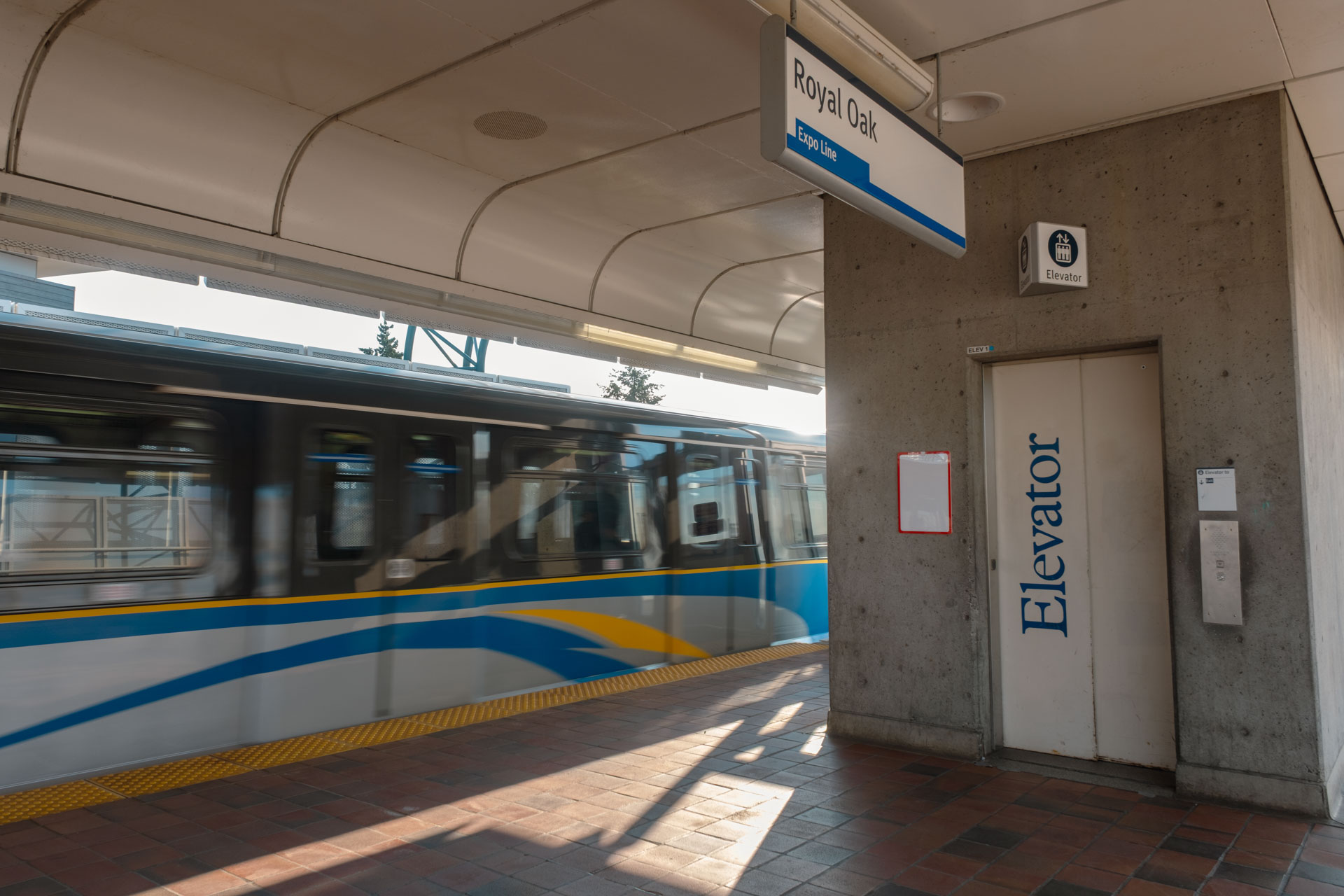
Heads up, transit riders! A brand-new, more spacious elevator is now open at Stadium–Chinatown Station, completing 6 elevator replacements in total across the Expo Line.
Why does this matter?
It shows how we’re prioritizing accessibility and efficiency for riders, while modernizing original infrastructure across the Expo Line SkyTrain system.
There are now six new, upgraded elevators in service across four stations at:
- Stadium–Chinatown Station
- Waterfront Station
- 22nd Street Station (two elevators)
- Nanaimo Station (two elevators)
Each new elevator car has 20 per cent more space for mobility devices, bikes, strollers, luggage — and of course, people! These modern elevators are less prone to breakdowns and will be more resilient in warm weather.
They also require less downtime for maintenance, minimizing impacts on our customers and staff.
Replacement work is currently underway at Edmonds and Scott Road stations, and we hope to have those new elevators ready for service by June 2026.
This is all part of our ongoing Expo Line Elevator Replacement Program to replace 21 original elevators across 15 stations. After Edmonds and Scott Road stations are finished, we’re nearly halfway there.
Once complete, all the original Expo Line elevators will have been replaced with more modern and spacious ones designed to make the system easier to navigate for a wide range of our customers.
Why now?
SkyTrain officially welcomed its first customers on January 3, 1986 and was originally built in part as a showcase for Expo 86. The original line only went from Waterfront Station to New Westminster Station.
Since SkyTrain first started running over 40 years ago, Metro Vancouver’s population has more than doubled. Some of the original Expo Line elevators have been moving customers 20 hours a day, 365 days a year for four decades. While retiring at 40 might seem early for some, the average service life of an elevator car is about 30 years.
A big job
Each elevator takes about four months to replace. At stations with two elevators, only one is replaced at a time to keep the station accessible for customers. Replacing an elevator is a difficult process.
The work involves six key steps done by workers in very tight spaces:
- Disassemble the existing car while still in the elevator shaft.
- The existing elevator shaft must be hollowed out.
- New guide rail is installed in the elevator shaft.
- The new elevator car is assembled piece by piece within the confines of the elevator shaft — an arduous task even for experts.
- Once built, wiring and safety systems are installed to the shaft and car.
- Thorough testing needs to be done to confirm safe operation of the new elevator before being opened to the public.
Take a deeper dive here and view pictures of how it’s all done: How elevators are replaced, explained – The Buzzer blog.
After FIFA World Cup 2026 Vancouver wraps up, TransLink will continue with the next phase of elevator replacements at Burrard Station and Royal Oak Station.
We appreciate the patience of our customers throughout these important infrastructure upgrades. Stay tuned for more updates!





So there’s 6 new elevators yet the new service station for the skytrain still isn’t completed yet. Hmmmm that’s funny to me. They said that would take approximately two years and now it’s heading into its third year from what it looks to be.
Unlike at Joyce-Collingwood west stationhouse, unfortunately, none of the elevators under the Expo line elevator replacement program have unique chimes audible to riders waiting outside respective elevators. Yet despite glass doors on some of the elevators covered in the program, they still have LCDs that don’t play any chime to audibly indicate elevator arrival and next travel direction to users waiting outside including blind riders. Who came up with the design that doesn’t include directional arrow lantern (i.e. audible and visual device for indicating elevator arrival and next travel direction) units, no matter in-car (i.e. visually and audibly indicate from inside elevator car to riders outside), hall (i.e. visually and audibly indicate from outside elevator to riders outside), or both, yet have each call buttons panel equipped with LCDs that don’t really benefit blind users much? How can TransLink and BCRTC afford each call buttons panel a 2.8″ LCD but not lanterns? Why wasn’t each car doorway side by the car buttons panel not kept at least wide enough for lantern units despite front return wall being thin? Except Stadium-Chinatown floors S and C, and Edmonds (spoke to on-site elevator technicians and they told me call button panels for Edmonds will utilize original mounts) currently, why many new call buttons panels need to be mounted on the side with the earliest gap for exiting riders fitting through? At Stadium-Chinatown floor T, Nanaimo, and Waterfront Expo line floor S, the new elevators didn’t utilize original call button panel mounts like at Edmonds for optimal in-car lantern views and not wasting on new mounts. At Waterfront Expo line floor T and 22nd Street, despite new mounts with new hall doorframes, project failed to utilize the opportunity for new mounts on opposite side of current call button panels for optimal in-car lantern views. I’ve conducted multiple informal tests on these 6 elevators involving not looking at respective elevators but rely on what blind users would use safely. Unless there is someone actually nudges, no one reminded me when the elevator arrived and it’s time to board. Also, unless there was no train rumbling and whizzing by the respective elevators, no emergency service blaring their sirens, no semi-trailer trucks passing by, or respective elevators located in areas where ambient noises have been significantly reduced, I was unable to sense the elevator arrived without peeking or risk getting any of my body parts pinched in door gaps. At least one instance involved elevator leaving without me. Other times, after the elevator arrived and opened its doors, it then closed its door unless I peek and press the call button to reopen doors. Elevators leaving without respective riders can lead to missing critical bus connections especially with low frequencies. Regarding Edmonds new elevators, I learned that the onsite technicians already put in place many Platform 1 elevator car components including the car doorframe. Car doorframe is like at Stadium-Chinatown and Waterfront, yet I recall from chatting with an onsite technician that to widen it for an in-car lantern, which would require more than a few millimeters (?), would require major elevator changes. Major elevator changes also apply to adding hall lanterns to hall doorframes. TransLink and BCRTC has compromised certain accessibility aspects by wasting resources on unnecessary components over emulating Joyce-Collingwood west stationhouse elevator’s simplicity with glass doors, simple call button panels, and lanterns visible to riders waiting in front of call button panels yet adapt lantern and call buttons panels with swapped positions in accommodating each side’s thin front return walls. TransLink and BCRTC must correct the flaws immediately by adding lanterns even if it means performing major changes on completed and in-progress elevators that includes replacing respective current call buttons panels with new ones mounted on the side for optimal in-car lantern views even if each new panel lack an LCD for maintenance simplicity, widening each car doorframe side by car buttons panel and opposite from respective front return wall, and replacing each car buttons panel’s LCD with a car doorframe LCD that functions both as a lantern and floor position indicator (PI; i.e. device displaying elevator floor position) and is at least 4.3″ portrait. Lantern and floor PI combo units, including LCD variants, in doorways are not unheard of. Alternatively, because TransLink and BCRTC can somehow afford each current call buttons panel a 2.8″ LCD, each landing per elevator be equipped with either a larger LCD functioning both as a lantern and floor PI equipped with an audio unit or a simple hall lantern unit at least 183 cm from respective floor even if it means removing the 2.8″ LCD for maintenance simplicity. In Stadium-Chinatown’s case, in-car lanterns must be added since floors S and C did not receive new doorframes. As for Scott Road, if front return wall is thin like other elevators in the program and due to street level landing getting a new doorframe with original call button panel mount demolished, the trains platform landing better be also getting a new door frame, car doorframe must have the side adjacent to a sidewall and opposite of the front return wall wide enough for in-car lantern, and each call button panel be positioned on the front return wall side for optimal in-car lantern views. Car buttons panel this time be not equipped with an LCD, but LCD be in the in-car lantern spot functioning both as a lantern and floor PI, and car buttons panel be side-mounted adjacent to the doorframe like other elevators in the program. Each call button panel be kept simple assuming every door will be glass.
Where is the “20% more room” figure coming from? As far as I can tell, these elevators are exactly the same size as the originals.
I agree, they barely look different in terms of space dimensions. Also, they lack directional arrow lantern units in the doorways like the original elevators, Joyce-Collingwood SkyTrain west stationhouse, and Waterfront SeaBus station. For such new replacements, they are lacking audible and visual directional arrow signals units. When ambient noises (e.g. SkyTrains, emergency service sirens, semi-trailer trucks) override elevator noises on the outside, there is no way knowing about elevator arrival and next travel direction. TransLink/BCRTC failed to maintain simplicity like at Joyce-Collingwood west stationhouse which each call buttons panel has only buttons and key switches and no LCD, and car only has the car buttons panel and in-car lantern since it has glass doors like the 6 elevators and upcoming Edmonds station Platform 1 elevator but wasted resources on an LCD per call buttons panel for all the six elevators plus upcoming Edmonds station Platform 1 elevator. Even with thin front return walls on each side, that isn’t an excuse to not get clever with each car doorframe side on a sidewall opposite from the thin front return wall kept at least wide enough for the in-car lanterns and call buttons panel position to be on the thin front return wall side opposite of the in-car lantern sides.