


Indigenous art on SkyTrain pillars in New Westminster
Indigenous art on SkyTrain pillars in New Westminster
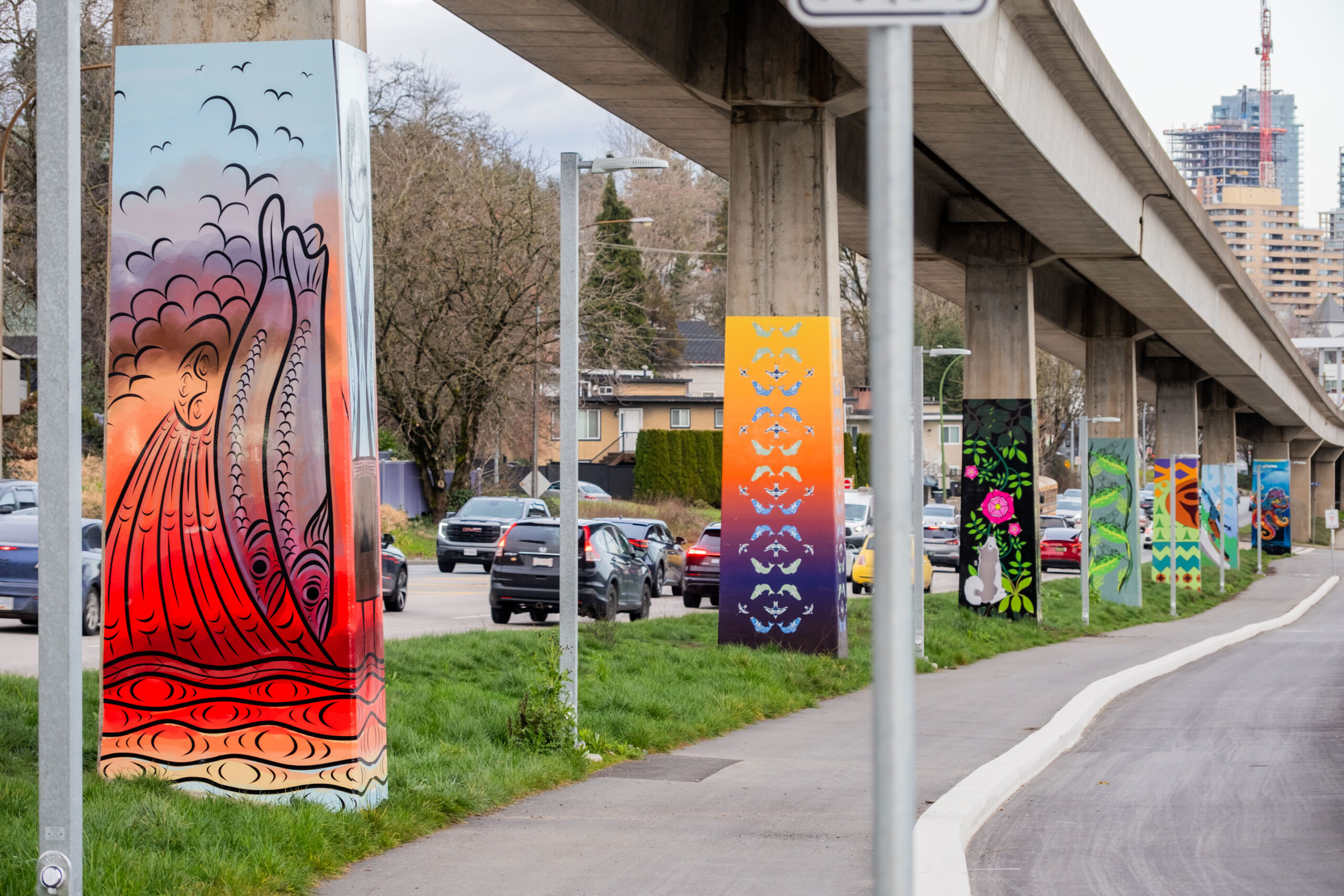
If you travel between 22nd Street and New Westminster SkyTrain stations on Expo Line, you’re traveling beside the newest public art installation on transit. Seven indigenous artists from diverse Nations have designed the vibrant artwork that grace SkyTrain guideway pillars along Stewardson Way in New Westminster.
The artwork represents diverse Indigenous cultural expression and honours the historical and cultural significance of the area near the Fraser River where the SkyTrain runs today. The art installation is part of the upgrades to BC Parkway along Stewardson Way that brought separated cycling and pedestrian lanes and improved street-level visibility to offer a comfortable, safe, and enjoyable active transportation route for those who live, work, and play in the Metro Vancouver region.
Installation of the artworks and the traditional blessing ceremony were completed in March 2026.
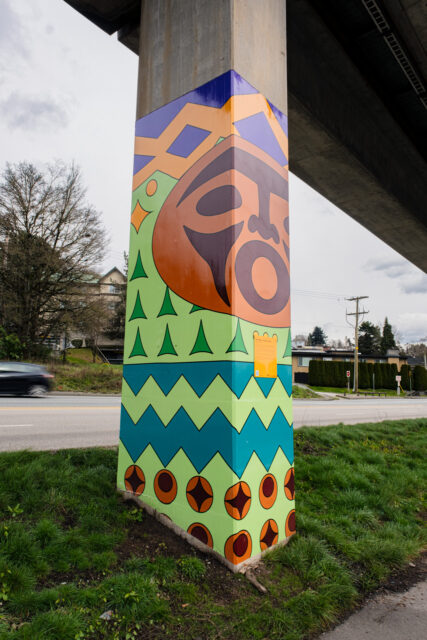
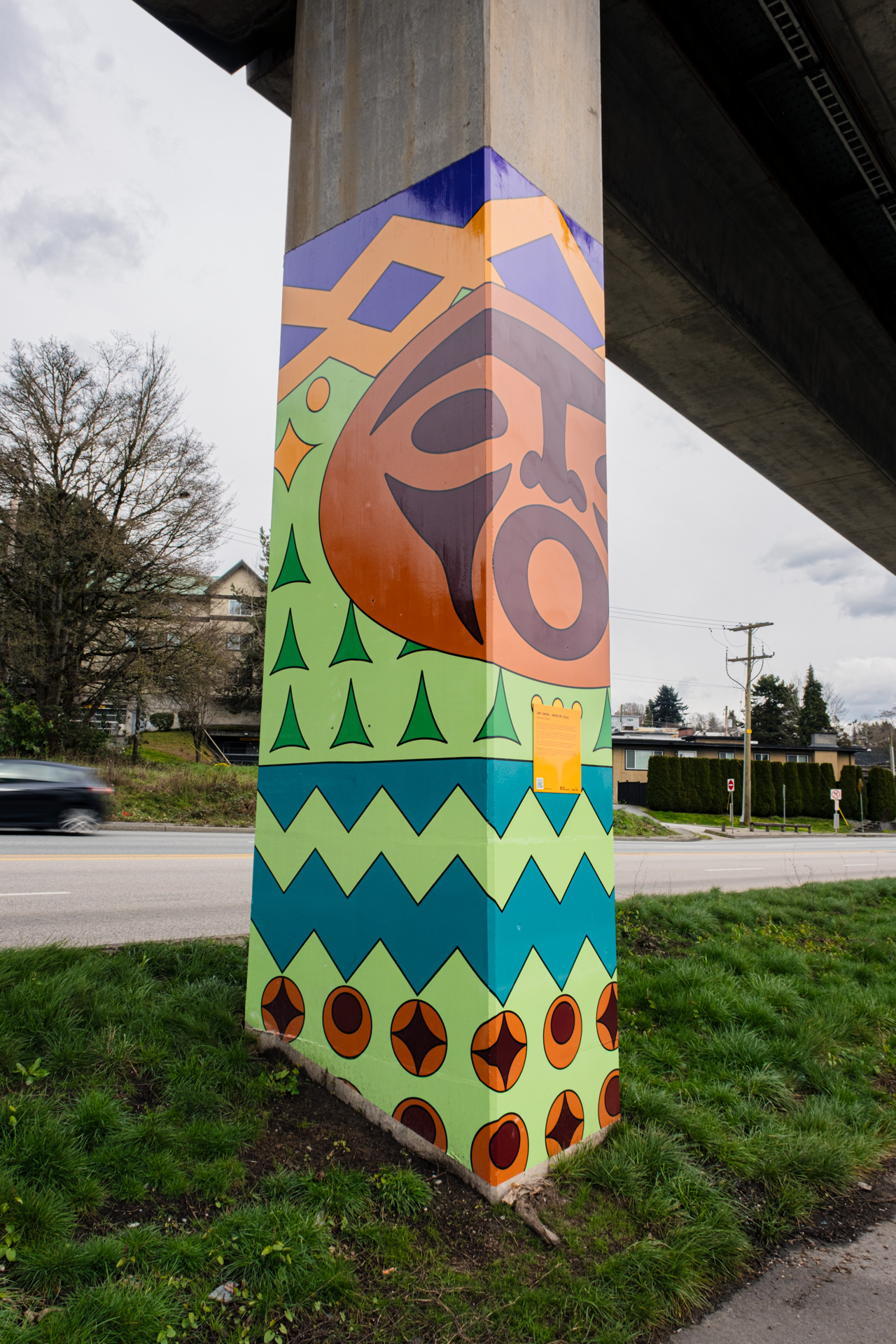
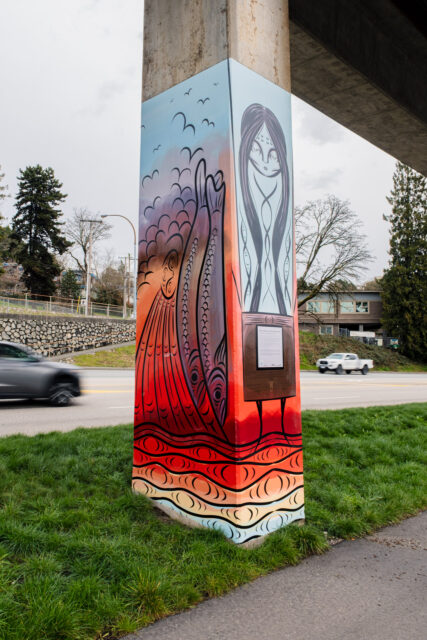 Breath of Eulachon by Ronnie Dean Harris / Malō:yhleq – Kʷeləs
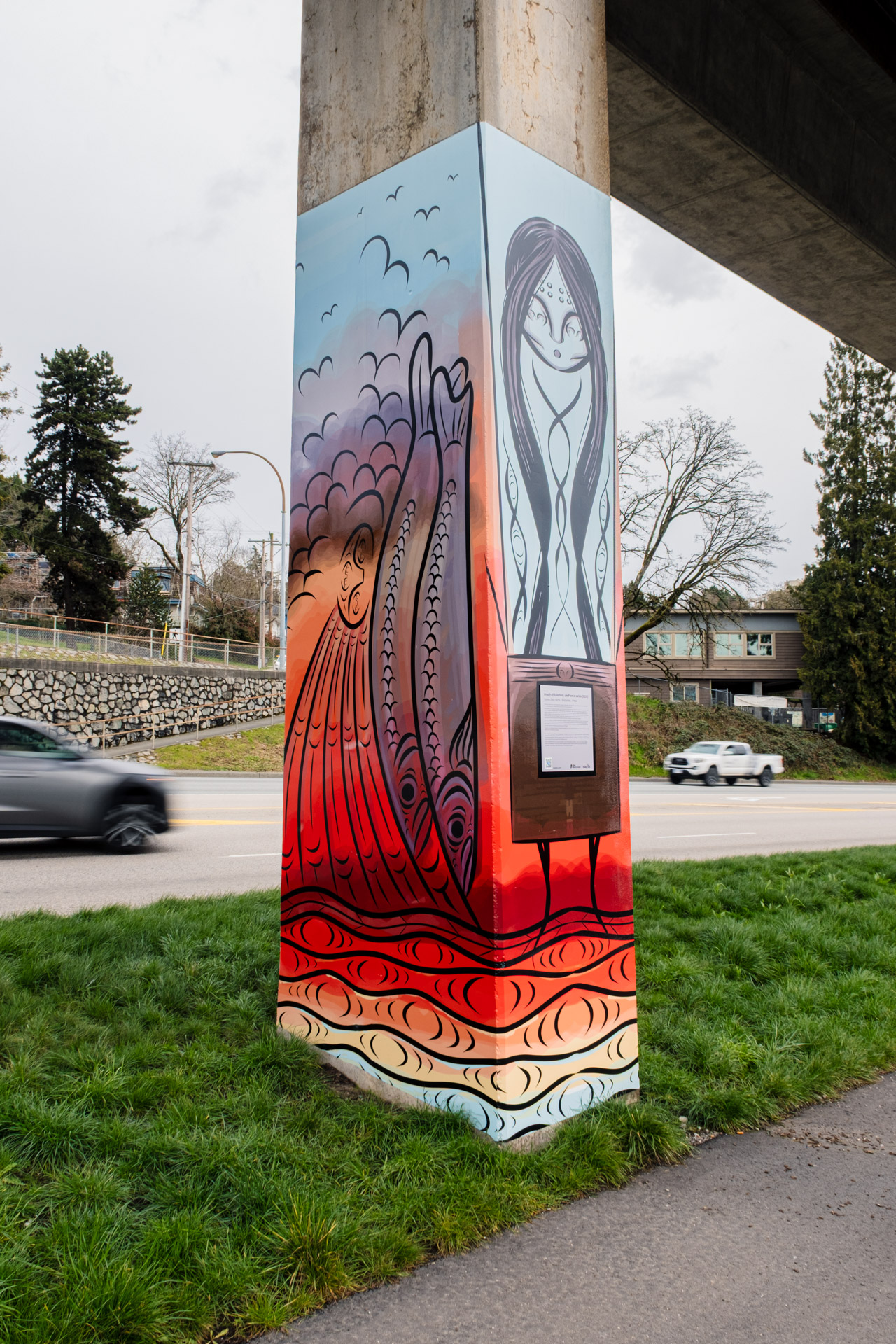
Breath of Eulachon builds on a story from a time before the creation of the delta, when the area near where the Pattullo Bridge sits was still seawater.
It recounts how one of Swaneset’s wives returned from the sky carrying a dowry box from her father. After gathering the people, she opened one side and released white feathers that became seagulls. After instructing the people to gather moss, she opened the other side and released eulachon into the waters near Pitt River.
Ronnie Dean Harris aka Ostwelve (Malō:yhleq – Kʷeləs) is a Stō:lo/St’át’imc/Nlaka’pamux artist, researcher, and community leader in New Westminster BC. Ronnie was raised in Kwantlen territory at Albion; he later spent time at Musqueam and settled in New Westminster in 2019 with his family.
Growing up in Albion, he recalls watching for seagulls in spring as families gathered to harvest eulachon, a vital cultural keystone species and indicator of watershed health.
His work bridges music, film, sound design, and Indigenous land-based storytelling. Ronnie’s research explores Indigenous history, cosmology, genealogy, and policy, informing his community-based projects and facilitation work. Local to New Westminster, his great-grandfather was Chief Kwikwetlem William, whose wife Celestine (Mabel) came from Tsawwassen.
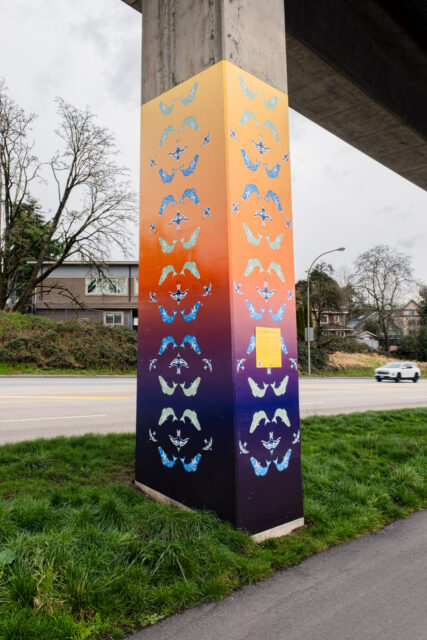 Swimming and Flight, Movement in Sight by Natache Gabriel
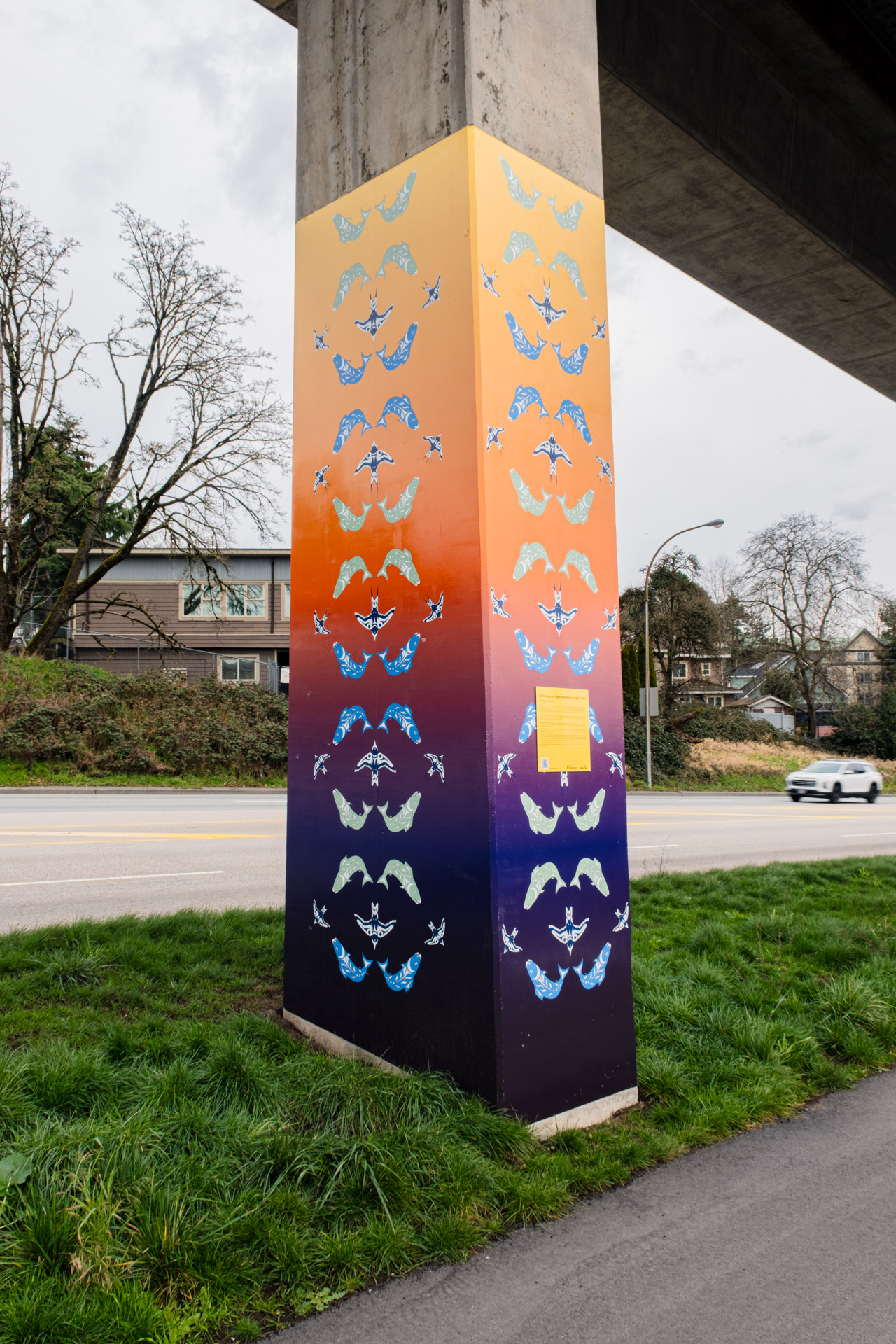
Swimming and Flight, Movement in Sight depicts salmon as more than a food source, reflecting livelihood, the life cycle, and a healthy environment.
It builds on the artist’s earliest childhood memories of harvesting salmon with her family and more recent experiences of her own children fishing for sockeye. From egg to spawning adult, the salmon’s life cycle mirrors our own, while declining sockeye numbers point to overfishing and environmental issues.
The Sparrow, although small, is a symbol of joy, friendship, resourcefulness, contentment, and hope. Birds are thought of as messengers and protectors. The sparrow has a life span of three years – a reminder to not take life for granted. They are also a symbol of abundance.
Natache Gabriel has roots that are deeply embedded in the lands of Fort Langley on Kwantlen territory where she resides with her fiancée and their four wonderful children. She draws inspiration from the rich tapestry of nature, family heritage, and the unfolding stories of current and past events which she reflects in her works.
Creativity runs deep in Natache’s lineage through her brothers, who are remarkable artists in their own right, to her parents. Natache acknowledges her relations and ancestors and expresses their teachings throughout her artwork. Her mother hails from a line of esteemed chiefs in Kwantlen who have left a legacy that continues to thrive today. Natache’s father comes from a lineage rooted in Kwantlen and St’sailes (Chehalis).
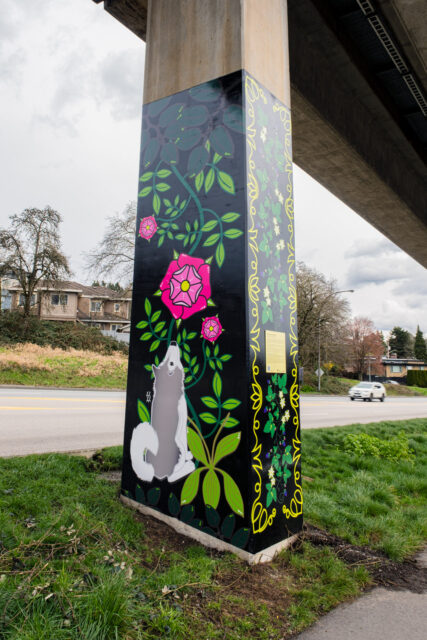 Gifts of the Land by Adele ᒪᐢᑿᓱᐤᐃᐢᑵᐤ Arseneau
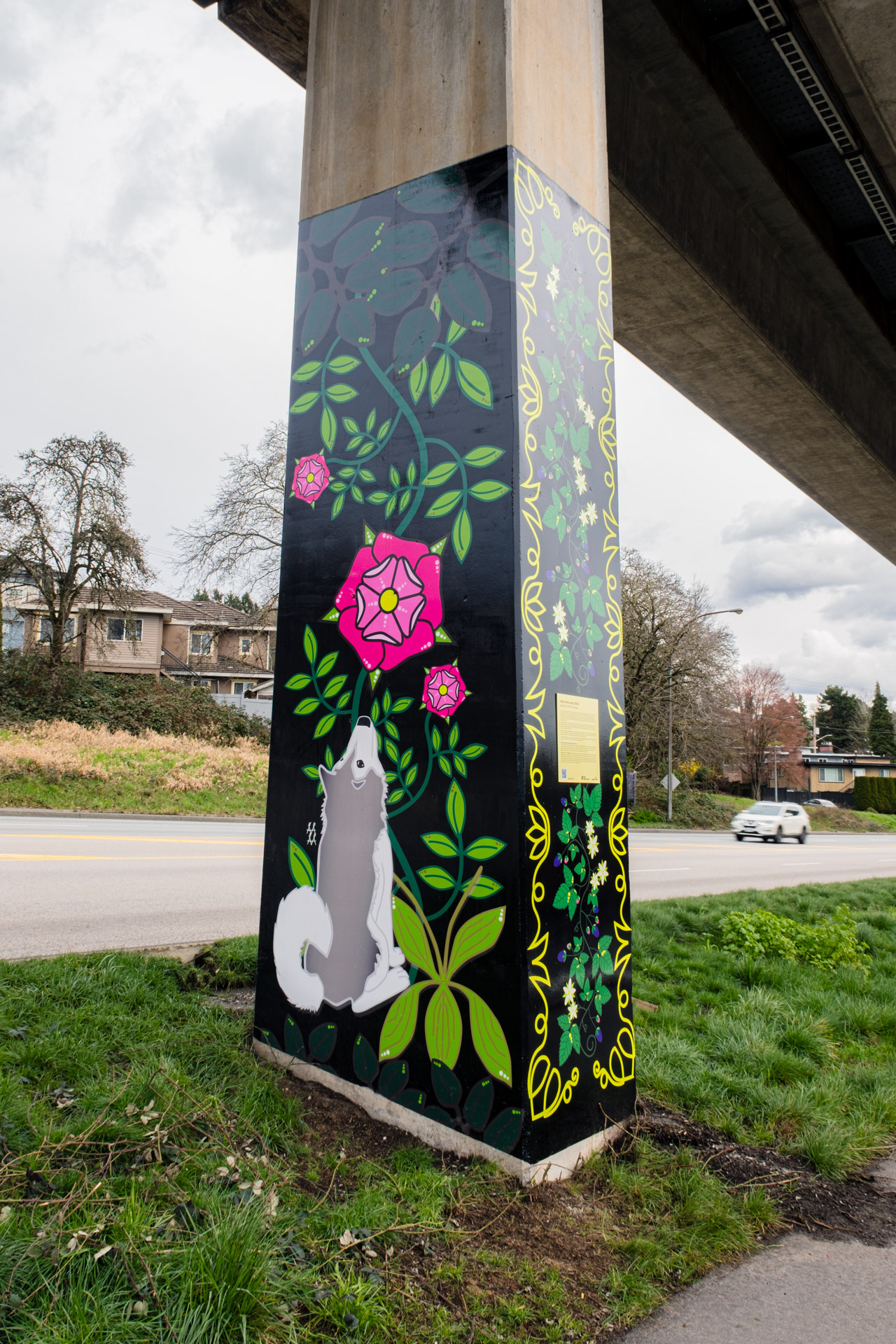
Gifts of the Land highlights medicines long connected to Indigenous life and found along the river and forest edges: wild rose (kálkay), plantain, salal (t’aka7ay), and Pacific trailing blackberry (skw’elm’xw).
Each carries its own teachings and medicine. Each carries its own teachings and medicine. Together, they speak to beauty, healing, protection, abundance, and strength. The artwork reflects the artist’s understanding of land as an integral part of Indigenous identity.
Created in the style of the artist’s beadwork patterns, the work presents these plants as more than decoration. It draws on beadwork as a language of memory and survival, connecting generations through story and skill. Placed along the pathway, the piece invites viewers to pause and consider the quiet generosity of the land.
Adele ᒪᐢᑿᓱᐤᐃᐢᑵᐤ Arseneau is a disabled nehiyaw and a deeply rooted Métis multidisciplinary artist, Knowledge Keeper/Elder, and advocate for cultural reclamation and accessibility.
A former Geomatic Engineer, she transitioned to full-time art after a stroke in 2018, using traditional beadwork, hide tanning, carving, and digital media to preserve her family’s Indigenous stories and language.
Her work has exhibited across Canada, including Tāpis: A Love Letter to our Dog Kin, which revitalizes knowledge of Indigenous dog blankets. A dedicated mentor and consultant, she continues to bridge art, history, and advocacy.
 Leaping into Change by Gracielene Ulu
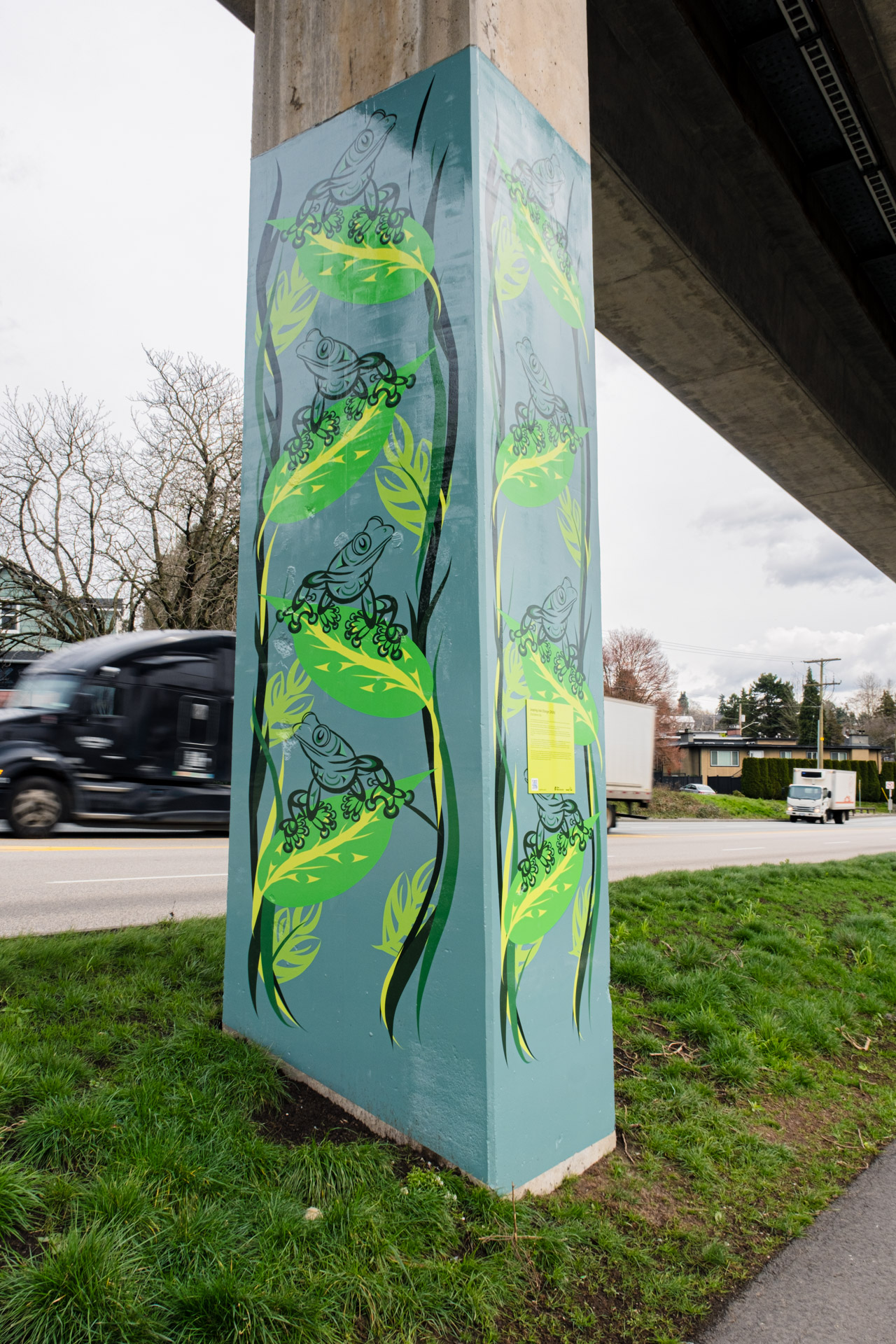
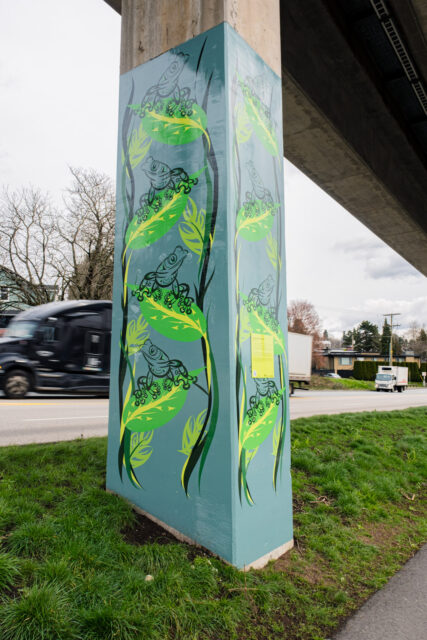
Leaping into Change depicts the spirit of the frog in the bustling heart of our city, where the SkyTrain glides gracefully along its tracks.
Here, the spirit of the frog takes on a new meaning, symbolizing the connections. With every leap between stations, people are not just traveling; they are discovering the pulse of their community. Each stop reveals a new landscape, a different neighborhood with unique stories.
Like frogs transitioning from water to land, these adventures encourage us to embrace change, to appreciate the beauty in the unknown while honouring the land. The SkyTrain creates an exhilarating atmosphere, allowing youth, elders, and all ages to connect with one another while fostering a sense of belonging that transcends generations.
Gracielene Ulu is an Indigenous artist of xʷməθkʷəy̓əm (Musqueam) and Fijian descent who strives to create meaningful connections between her heritage and the contemporary art landscape.
Her mother is from xʷməθkʷəy̓əm (Musqueam), her father from Fiji, and her grandparents from xwməθkwəy̓əm and Snuneymuxw (Nanaimo). This diverse cultural background informs Gracielene’s artistic practice and inspires her to explore themes of community, place, and cultural traditions.
With over five years of experience in public art, Gracielene weaves family history and ancestral stories into her work, reflecting on how vital Indigenous cultural expression is to identity, tradition, belief systems, and everyday life — carrying meaning far beyond contemporary art. This understanding shapes how Gracielene approaches public art, keeping her work grounded in her heritage, community, and the teachings passed down through her family.
 Qwo’ Xwong : : Water Cry by Roxanne Charles
Qwo’ Xwong :: Water Cry honours the deep relationship that Salish peoples have with this territory and gives thanks to the waterways that have provided abundance since time immemorial.
For generations, these waterways provided deep nourishment, but today only a fraction remains, with lasting impacts on wellbeing.
Today orcas, salmon, and many other ocean beings face warming waters, malnourishment, disease, contamination and vessel traffic, the work calls for a better way of living in relation to these waters.
This design was created in ceremony and prayer to speak up for those who cannot speak for themselves. The weaving stands along the shore, a reminder of water as a life giver and calls on viewers to be good guests on these lands and waters, to walk gently, and to care for them.
Roxanne Charles of Semiahmoo First Nation is a cultural historian employing means of visual representation, oral history, and ceremony. Methods which have been utilized by Semiahma People for thousands of years.
Her work explores and documents a variety of issues that reflect her daily life such as spirituality, identity, urbanization, trauma, and various forms of systemic violence.
 Connections Through Time by Austin Aan’yas Harry
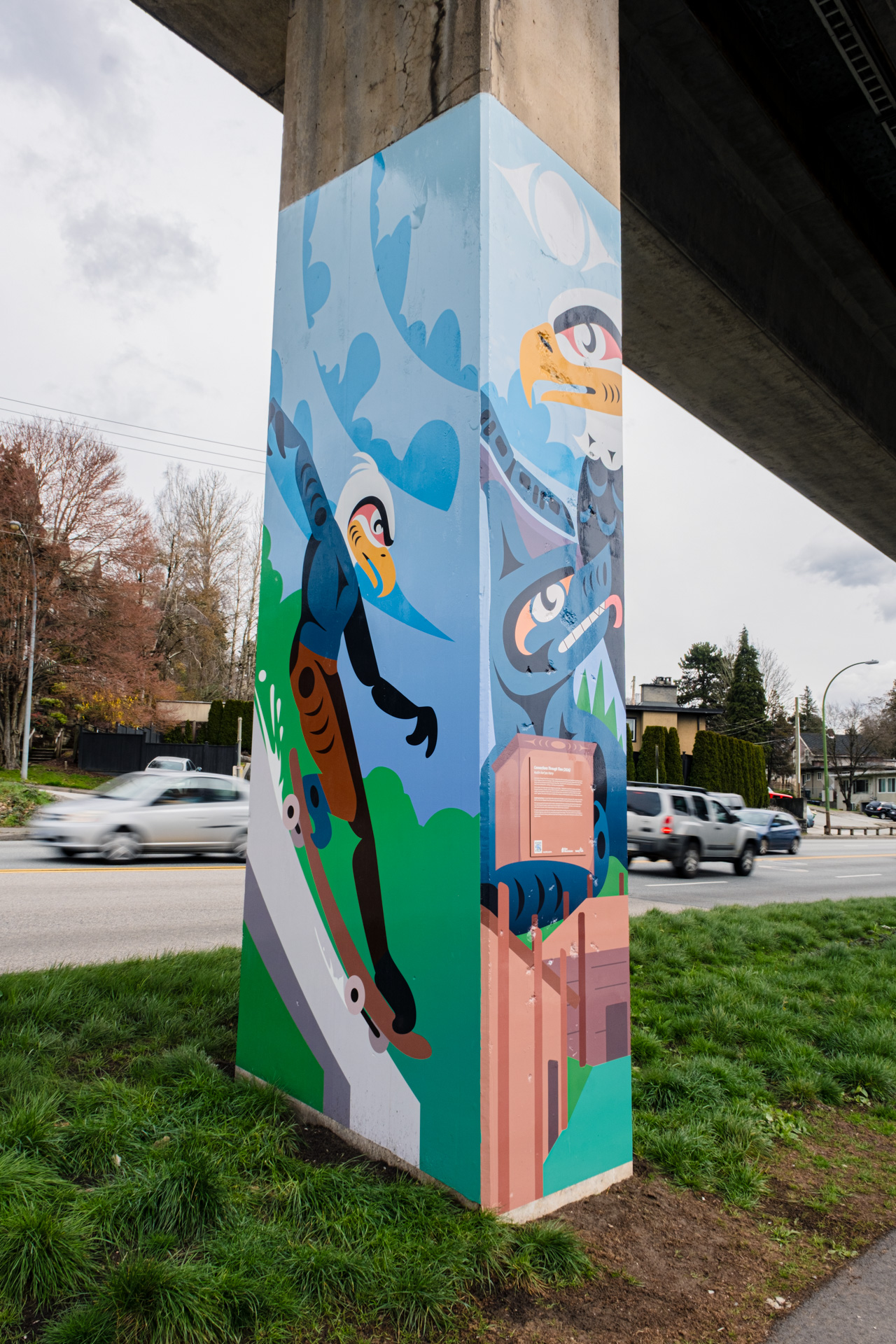
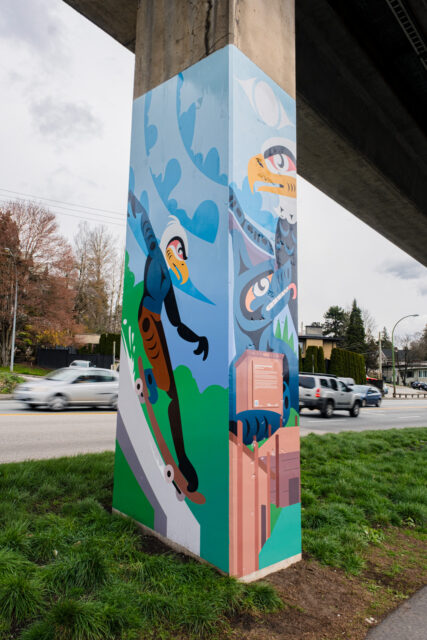
Connections Through Time links ancestral relationships to this land with the artist’s own experiences growing up as an urban Indigenous youth.
It draws on the artist’s memories of skateboarding along this SkyTrain path as a teenager, later recognized as echoing the routes of the artist’s ancestors who would travel by the Fraser River.
In the artwork, the Eagle represents Indigenous youth today – finding their connection to culture and history through movement, curiosity, and the rhythms of daily life. The Wolf embodies the enduring presence of our ancestors, whose guidance remains with us as we rediscover these connections in new forms within the modern world. Together, they reflect the layers of relationship, memory, and belonging that continue to shape who we are.
Austin Aan’yas Harry is a Coast Salish Artist and founder of Indigital, based in Vancouver, BC, Canada. He is of the Wolf Clan from the Sḵwx̱wú7mesh Úxwumixw (Squamish Nation) and Thunderbird Clan from the ‘Namgis Nation. From a young age Austin worked with his father, Xwalacktun Rick Harry, teaching youth about the history and culture of the Squamish people.
Austin found a love for digital art and media through movies, comic books, and video games, but saw a lack of representation of the culture he was so proud of. His dream of bringing Indigenous culture into the mainstream through art and design led Austin to found Indigital – a company dedicated to sharing traditional Coast Salish heritage and culture with contemporary audiences through digital media.
 Octopus Sxweli by Brandon Gabriel
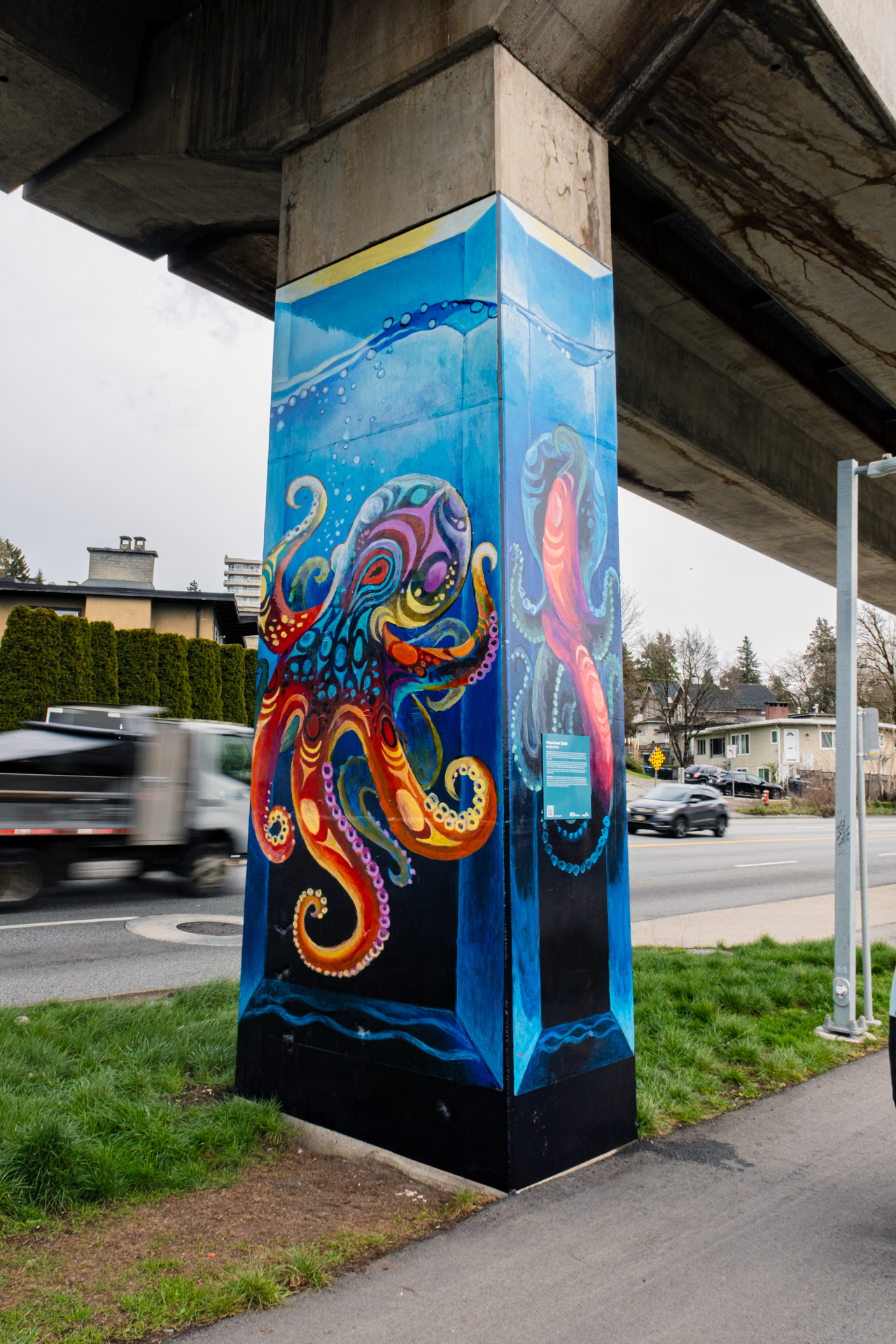
Octopus Sxweli presents a vividly coloured octopus suspended within a glass fish tank, an image that is intentionally confounding.
Octopi are wild, intelligent ocean dwellers, rarely associated with captivity or freshwater environments. Here, the creature appears displaced—held within a vessel that suggests domestication and control—mirroring the layered tensions between place, culture, and perception.
Originally hand-painted in acrylic on hardboard, the work blends hyper-realistic imagery with Coast Salish heraldic design elements embedded throughout the form. Trigons, crescents, ovals, Y-shapes, and U-shapes reference ancestral visual language, asserting Indigenous presence within a contemporary urban setting.
The octopus becomes both guardian and captive—an emblem of resilience, adaptability, and cultural survival—inviting viewers to reflect on movement, containment, and the unseen histories that shape the spaces we pass through each day.
Brandon Gabriel is a visual artist from the Kwantlen First Nation in the Lower Mainland of British Columbia. He holds a Bachelor of Fine Arts in Visual Art with a minor in Indigenous Studies from Emily Carr University of Art and Design, and studied Cultural Anthropology, Marketing, and Visual Arts at Kwantlen Polytechnic University.
His practice is rooted in Coast Salish visual traditions and includes painting, drum making, muralism, sculpture, and design. Drawing on heraldic imagery, and ancestral teachings; Gabriel’s work explores cultural continuity, identity, and Indigenous presence within contemporary art contexts.
To learn more about public art on transit, visit our Public Art Map.